Can you reconstruct a loan schedule without trusting its headline total?
Held constant: A monthly rate of 0.5%, cent-rounded interest and a $365.06 scheduled payment.
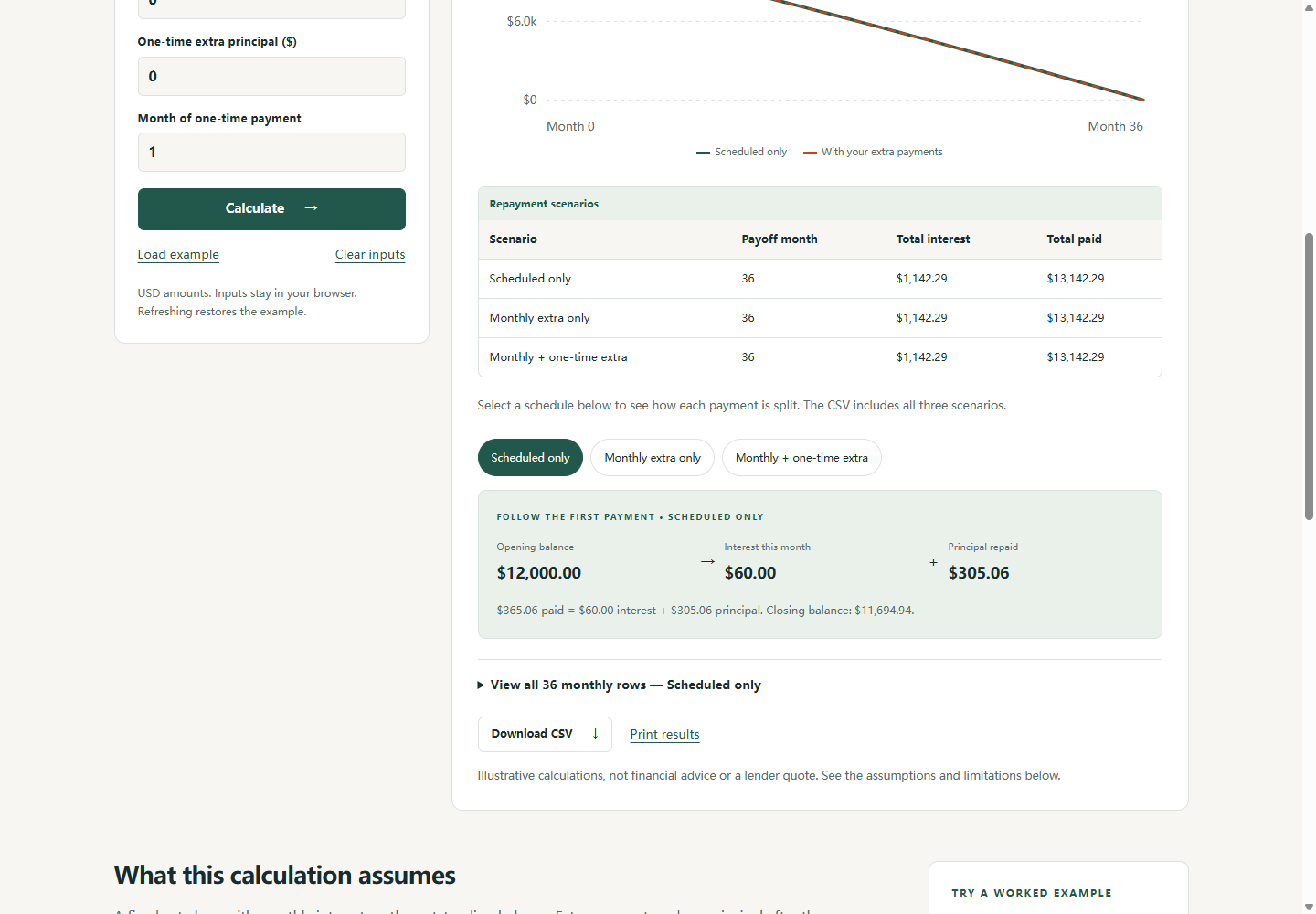
A repayment table is easier to understand when you can reconstruct a single row. This worked example uses a $12,000 starting balance, a fixed 6% annual interest rate, 36 monthly periods and no extra payments. We keep the scheduled payment at $365.06 and follow how its split changes in the first three months. This is a constructed schedule, not a statement supplied by a lender.
| Month | Opening | Payment | Interest | Principal | Closing |
|---|---|---|---|---|---|
| 1 | $12,000.00 | $365.06 | $60.00 | $305.06 | $11,694.94 |
| 2 | $11,694.94 | $365.06 | $58.47 | $306.59 | $11,388.35 |
| 3 | $11,388.35 | $365.06 | $56.94 | $308.12 | $11,080.23 |
Download this example’s CSV · Load the inputs in the calculator
Start with the interest period
Divide the nominal annual rate by 12: 6% ÷ 12 = 0.5% per monthly period. The first row opens at $12,000. Multiplying by 0.005 gives $60.00 of interest. This model uses equal monthly periods; there is no count of the actual days between payment dates. A statement using daily interest cannot be reconciled by this step without adapting the convention.
Reconcile the first row
The $365.06 payment has two uses: $60.00 covers interest and $305.06 reduces principal. Subtract only the principal portion from the opening loan balance: $12,000 − $305.06 = $11,694.94. Subtracting the entire payment would incorrectly produce $11,634.94, as though no interest had been charged. The first closing balance becomes the next row’s opening balance.
Repeat the process for month two
The next interest calculation is $11,694.94 × 0.005 = $58.4747, rounded to $58.47. The same $365.06 payment now repays $306.59 of principal, leaving $11,388.35. There is more principal reduction even though the payment and interest rate did not change. The reason is the smaller opening balance on which interest is calculated.
Use month three as a cross-check
Month three starts at $11,388.35. Interest is $56.94175, rounded to $56.94; principal repaid is $308.12; the closing balance is $11,080.23. Across the three months, payments total $1,095.18. Interest totals $175.41 and principal totals $919.77. Those two components add back to the payment total, and $12,000 − $919.77 returns the same closing balance.
Know which fields you are comparing
A total amount debited from a bank account may contain items outside principal and interest. This example does not include taxes, insurance, servicing charges, origination costs or penalties. If a real statement differs, first identify its opening date, rate convention, charge items and payment allocation. Do not assume a difference means the lender or calculator is wrong.
Make one deliberate change
Load the example, keep the balance, rate and term, then add $50 of monthly extra principal. Select Scheduled only and Monthly extra only below the comparison to inspect the first-payment explanation. With the extra payment, the first closing balance becomes $11,644.94. Next month’s modeled interest falls from $58.47 to $58.22. This isolates the mechanism of an overpayment without changing the nominal rate.
Download and reconcile the full schedule
The CSV contains all three calculator scenarios; in this no-extra example they match. Filter to baseline when summing the schedule, so you do not count the same payments three times. Check each closing balance against the next opening balance, then check total principal against $12,000. The independent reference on our methods page verifies the complete baseline total with a separate decimal calculation.
The whole payment does not reduce the loan balance. Only the principal component does.
Check your understanding
After month one, is the loan balance $11,634.94 or $11,694.94?
Show the reasoning
$11,694.94. The payment includes $60.00 of interest, leaving $305.06 of principal reduction. Subtracting the full $365.06 would ignore the interest charge.