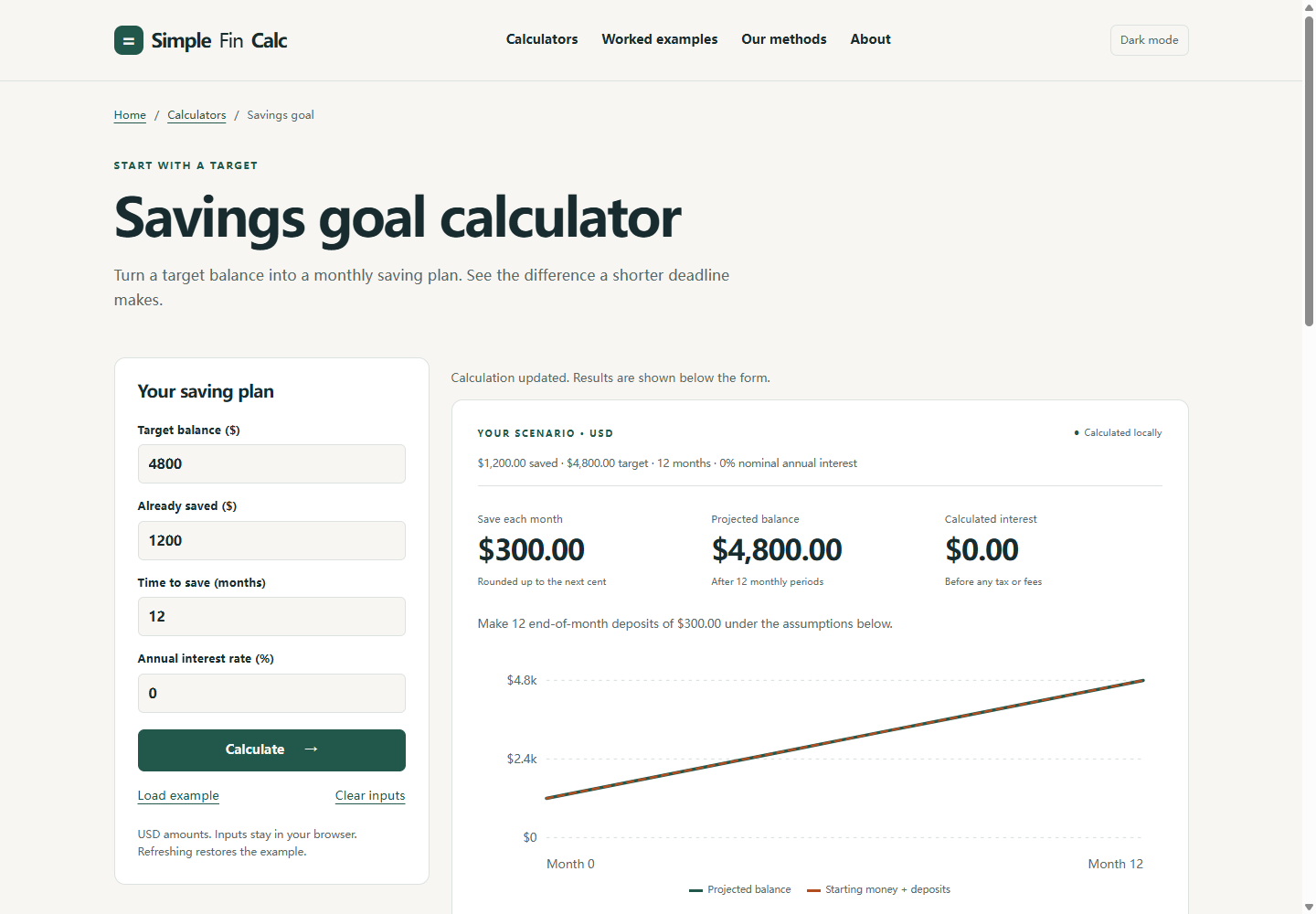
Suppose you are setting aside money for a planned expense. You want $4,800, already have $1,200, and can make one deposit at the end of each month. There is no interest in this example. That is intentional: a zero-rate plan makes it easy to verify the result without depending on a savings rate that may change.
| Scenario | Monthly deposit | Deposits | Final balance |
|---|---|---|---|
| Original deadline | $300.00 | 12 | $4,800.00 |
| Earlier deadline | $400.00 | 9 | $4,800.00 |
| Earlier, unchanged deposit | $300.00 | 9 | $3,900.00 |
Download this example’s CSV · Load the inputs in the calculator
Build the baseline before adding assumptions
The remaining amount is $4,800 − $1,200 = $3,600. Spread that over 12 deposits and the monthly requirement is $300. After month one, the balance is $1,500; after month six, $3,000; after month twelve, $4,800. The downloadable schedule contains each of these steps, so you can check the calculator with simple addition.
Shortening the deadline changes the deposit
With nine deposits instead of twelve, the same $3,600 gap requires $400 per month. You are not saving more overall; you are distributing the same amount across fewer deposits. This distinction matters when a purchase date moves forward: the target can stay unchanged while the monthly cash commitment rises.
What if $300 is the maximum you can contribute?
Nine deposits of $300 add $2,700. Combined with the existing $1,200, that gives $3,900 and leaves a $900 gap. The arithmetic does not tell you whether to borrow, postpone or reduce the purchase. It makes the trade-off visible: change the amount, the date or the planned deposit.
Try a rate without treating it as a promise
Load this example in the calculator and change the interest rate only after checking what rate convention your account uses. Our input is a nominal annual percentage compounded monthly, with deposits at month-end. It is not APY and does not include tax or account fees. Compare the new result with the zero-rate baseline before relying on it.
Reproduce and check
Use Target 4800, Already saved 1200, Months 12 and Rate 0. Change only Months to 9 for the comparison. The chart and CSV should end at the same balance. If you manually sum the CSV deposits, the total should be $3,600 for both versions. This is a constructed example, not a customer savings record.