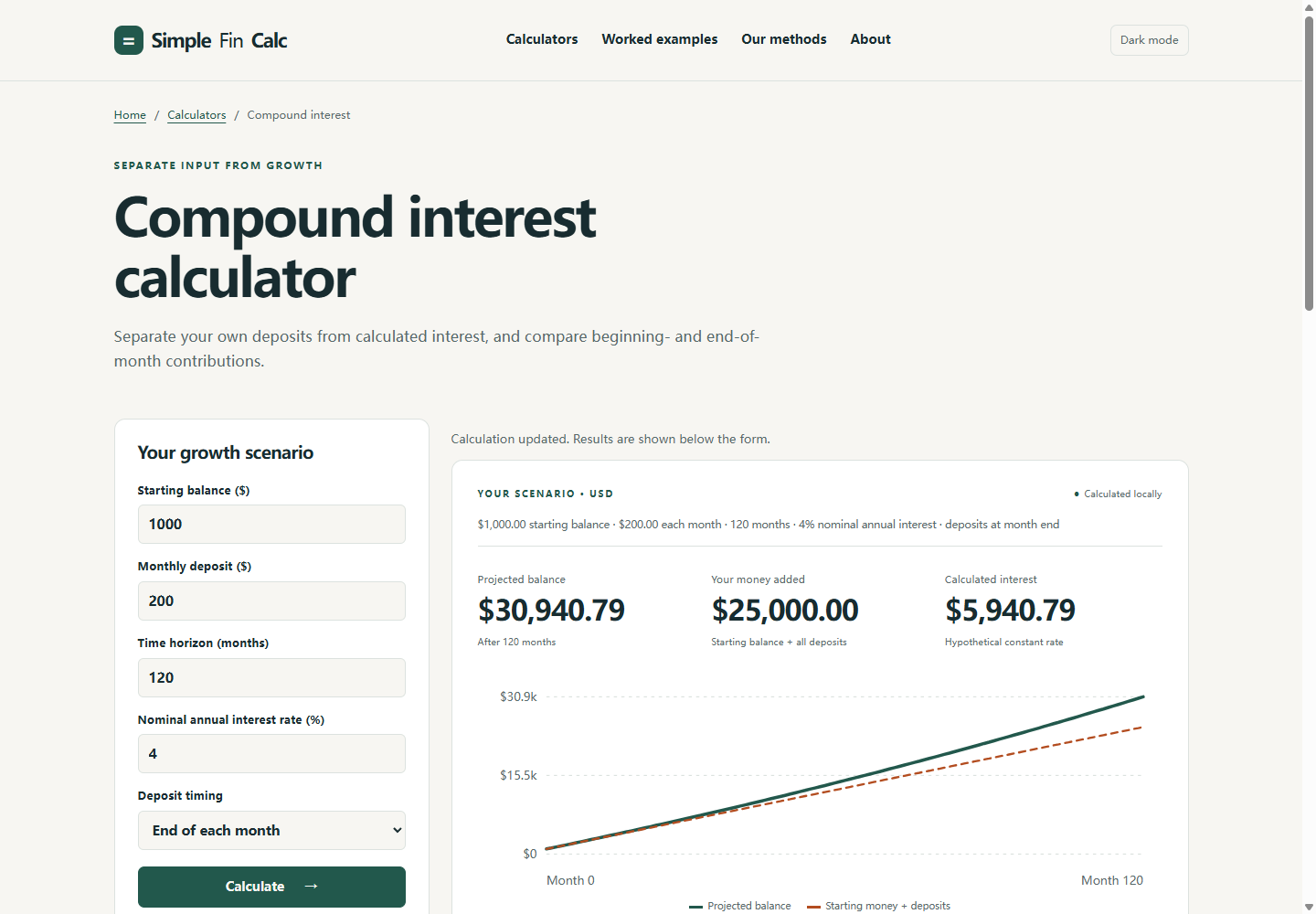
This example starts with $1,000, adds $200 each month for 120 months and uses a fixed nominal annual interest rate of 4%, compounded monthly. We compare deposits arriving just before monthly interest is applied with deposits arriving just after it. Both versions contain exactly the same $25,000 of starting money and new deposits.
| Timing | New deposits | Interest | Ending balance |
|---|---|---|---|
| End of month | $24,000.00 | $5,940.79 | $30,940.79 |
| Beginning of month | $24,000.00 | $6,038.96 | $31,038.96 |
Download this example’s CSV · Load the inputs in the calculator
Follow the first month
The monthly rate is 4 ÷ 1,200, or about 0.00333333. With an end-of-month deposit, the first interest calculation is $1,000 × 0.00333333 = $3.33333. The $200 deposit arrives afterward, leaving about $1,203.33. With a beginning-of-month deposit, interest applies to $1,200 and is exactly $4, leaving $1,204.
Why the difference persists
Each beginning-of-month deposit earns one more monthly period of interest than the equivalent end-of-month deposit. Starting money earns the same interest in both versions. That is why the annuity-due formula multiplies the deposit term by (1 + r), rather than multiplying the entire ending balance.
Separate deposits from interest
The table below distinguishes $24,000 of recurring deposits from interest. When reviewing a projection, this separation prevents mistaking your own contributions for growth. The starting $1,000 is shown separately in the tool as well. More deposits or a longer horizon can increase the ending balance even if the interest rate stays low.
Why a real account may differ
An account that calculates interest from daily balances will not follow our equal-month convention exactly. APY, nominal rate, compounding frequency, deposit posting dates, fees and tax can all affect a comparison. Match those conventions before treating two calculators’ different outputs as a calculation error.
Reproduce and check
Enter 1000, 200, 120 and 4, then switch deposit timing. Keep every other input unchanged. The downloadable comparison uses the same deterministic inputs. The implementation is tested against the closed-form ordinary annuity, and the timing test verifies the extra-period relationship. This illustration assumes a constant positive rate; it is not a forecast of investment returns.